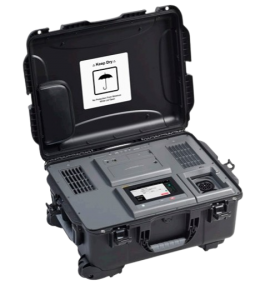
Model: FLK-FEV500/CCS1 | Order No: FEV500/CCS1
The FEV500 simplifies fast DC EV charger testing by combining safety, performance, and interoperability diagnostics into a single portable device. Its guided touchscreen workflow lets technicians quickly verify communication and charging functions on CCS-compatible stations without a vehicle.
This product exceeds standard shipping dimensions/weight, as such it does not qualify for free shipping. We will contact you with your shipping costs.
Built for field use, the FEV500 performs critical safety tests without opening the station—saving time and reducing risk. Integrated TruTest™ software automates documentation for compliance and maintenance records. Rugged, accurate, and intuitive, the FEV500 empowers technicians to keep fast-charging networks reliable and ready to power the future. The FEV500 has an intuitive interface and features seamless software integration, making it easier for technicians to troubleshoot, manage data, and maintain EVSE uptime with confidence and efficiency.
The FEV500 is compliant with ISO 15118 and DIN SPEC 70121 international standards for the digital communication between electric vehicles and electric vehicle supply equipment. It has been tested for compatibility with major EVSE manufacturers.
Features
Streamline Fast DC EV Charging inspections using one integrated tool
Other EVSE test tools often only support vehicle simulation and require other test equipment to perform a full inspection. This requires reconfiguration of test leads and the need to bring multiple devices on-site. Managing multiple devices can lead to inefficiencies, increased test time and higher likelihood of human error. The FEV500 consolidates all recommended electrical inspection steps into a single portable device. Technicians can test continuity, insulation, check IMDs (insulation monitoring devices), and residual voltage all through the EVSE connector without the need to use other devices
EVSE Validation: Independent, Precise Testing Without an EV On-Site
As electric vehicles become the norm, ensuring the reliability and performance of EV charging infrastructure is more critical than ever. Traditional validation methods often rely on the presence of an actual EV, which can limit flexibility and delay testing—especially in remote areas or during maintenance windows.
The Fluke FEV500 empowers technicians with a smarter approach: it simulates an EV, enabling comprehensive testing of charging and communication protocols without needing a vehicle on-site. This independence streamlines workflows, reduces downtime, and allows for repeatable diagnostics under controlled conditions. Technicians can replicate specific charging scenarios, verify protocol compliance, and troubleshoot issues with precision—anytime, anywhere.
By decoupling EVSE validation from vehicle availability, the FEV500 supports proactive infrastructure readiness for a fully electric future.
Simplify Every Step of Fast DC Charger Testing
The Fluke FEV500 streamlines Fast DC EVSE testing by combining safety, performance, and interoperability checks into one compact, field-ready tool. Its guided testing workflow walks technicians step-by-step through each protocol, ensuring consistency, confidence, and faster results, no matter what their experience level is. The FEV500 delivers EV-free validation, simulating real charging sessions and communication without needing a vehicle on-site, while error simulation verifies that safety systems respond correctly to faults. Designed for the field, it is portable, durable, and battery operated, with wheels and a handle for easy transport and no need for external power. The analyzer also consolidates multiple instruments— EV, protocol analyzer, low-ohm meter and oscilloscope —into a single device for complete non-invasive testing without opening the charger. Test data is automatically captured and transferred to TruTest™ software, eliminating manual entry and simplifying documentation for compliance and reporting. With the FEV500, technicians can test smarter, safer, and faster, anywhere the job takes them.
Automated Documentation: Removes the Need for Manual Data Entry
Manual data entry is a time-consuming and error-prone process that can lead to inaccuracies in test documentation, complicating maintenance records and compliance reporting. Technicians must often transcribe test results by hand from multiple test tools, which not only slows down the workflow but also increases the risk of data loss or incorrect entries.
The Fluke FEV500 automates the documentation process. Test results are automatically recorded and stored within the device and can be easily transferred to TruTest™ software via USB-C for further analysis and report generation. This automation eliminates the need for manual data entry, ensuring that all test results are accurately captured and documented. It also streamlines compliance reporting and maintenance planning, providing reliable, traceable records that can be accessed and shared as needed. This not only saves time but also enhances the overall efficiency and accuracy of the testing process
Applications
| Environmental | |
| Temperature | Operating: -4 to 122°F (-20 to 50°C) Storage: -4 to 140°F (-20 to 60°C) 32 to 86°F (0 to 30°C) recommended |
| Operating Humidity | IEC 60721-3-3: 3K6 -13 to 86°F (-25 to 30°C): ≤100% 104°F (40°C): 55% 122°F (50°C): 35% |
| Operating Altitude | 9843' (3000 m) |
| Storage Altitude | 39,370' (12000 m) |
| Vibration | IEC 60721-3-3 / 3M2 |
| Ingress Protection | IEC 60529 |
| Ingress Protection, Lid Closed | IP54 |
| Safety | IEC 61010-1: Pollution Degree 2 |
| Charging Temperature (Battery) | 32 to 113°F (0 to 45°C) |
| Electrical | |
| Voltage | Range: 1,000 V Resolution: 0.1 V Accuracy: ± (0.2% + 4 digits) |
| Current | Range: 10 A Resolution: 0.01 A Accuracy: ± (0.5% + 5 digits) |
| Power | Range: typ. 2 kW Resolution: 1 W Accuracy: typ. ± (0.7% rdg + 2 digit) |
| IMD Test | No Trip Test: 250 kΩ, asymmetric insulation resistance DC+ to PE Trip Test: 95 kΩ (max. EVSE voltage ≤500 V dc) 45 kΩ (max. EVSE voltage ≤500 V dc) asymmetric insulation resistance DC- to PE Time per test: <15 s Standard: IEC 61557-8 / IEC 61557-18 |
| Continuity (RLo) Test Lead to PE (CCS) | Test current: max 10 A Range: 2 Ω Resolution: 0.1 mΩ Accuracy: ≤20 mΩ: ±(8% + 8 mΩ) ≤200 mΩ: ±(4% + 10 mΩ) >200 mΩ: ±(4% + 40 mΩ) Standard: IEC 61557-4 |
| Insulation Resistance DC+ to PE and DC- to PE | Test voltage: 500 V Range: 10 kΩ to 20 MΩ Resolution: 0.01 MΩ Accuracy: ±(5% rdg + 2 digit) Test voltage: 1000 V Range: 10 kΩ to 20 MΩ Resolution: 0.01 MΩ Accuracy: ±(5% rdg + 2 digit Max Short Circuit Current: 2 mA Standard: IEC 61557-2 |
| CP Test (CCS1, CCS2) | Simulation of States: RanA, B, C, D, E CP High, CP Low: Range: 15 V to +15 V Resolution: 0.01 V Accuracy: ±(0.4% rdg + 2 digit) Frequency Measurement: Range: DC, 900 Hz to 1100 Hz Resolution: 1 Hz Accuracy: 0.1% or 1 digit Duty Cycle: 2 to 98 % Resolution: 0.10% Accuracy: ±5 digit PP Resistor: Range: 50 to 499.9 Ω Resolution: 0.1 Ω Accuracy: ±0.5 % Range: 500 to 5000 Ω Resolution: 1 Ω Accuracy: ±0.5 % Digital Protocol: DIN 70121, ISO 15118 SLAC: Range: 0 to 20 dB Resolution: 1 dB |
| General | |
| Display | 7" (17.78 cm) capacitive touchscreen (1024 x 600) Brightness up to 1,700 cd/m² (auto-adjusted) |
| Keys | Power on/off, Backlight, Stop Test |
| LED Indicators | Green: Power on Red: Low battery Blue: Charging Amber: Fan active when device is off |
| USB-C Ports | USB-C power delivery charging, Flash drive TruTest™ connection, Calibration |
| GNSS | Global navigation satellite receiver with internal antenna for time synchronization |
| Battery Type | Li-ion RRC2040-2 (customer replaceable) |
| Battery Capacity | 10.8 V, 6.8 Ah, 73.44 Wh |
| Battery Runtime | 10 hours (recharges during test) |
| Charging Time | 3 hours (with 65W USB-C PD) |
| Battery Backup Time Before Recharging Required | 6 months |
| Fuse | 11 A (not customer replaceable) |
| Dimensions | 25.6 x 20 x 11.8" (650 x 508 x 300 mm) |
| Weight | 57.3 lbs (26 kg) |
We accept these payment methods:

We also accept wire transfers/EFT, cheques and purchase orders on approved credit. Accepted payment methods vary by country.